Buy car, get butter

My Swedish colleague, Dr Andreas Eenfeldt, has been doing a lot to promote LCHF both in Sweden and abroad. I have spent time with him at the scientific meetings we both attend. He wrote about my research and My Big Fat Diet in his recent book which has become a best-seller in Sweden and which is being translated into other languages. Unfortunately, I don’t think it is available in English, yet. He also did a video interview with me which is posted on his blog and is also available on YouTube (http://www.youtube.com/watch?v=U4y8-1J_Jqw).

A few years back, I was at a scientific conference on pre-diabetes and metabolic syndrome in Barcelona. As usual in these meetings, everything was oriented towards pharmaceutical interventions with little mention of diet. In fact, the only time diet was referenced in virtually all sessions was when people would say, almost robotically: “caused by a high fat diet”. The prevailing meme was that obesity, pre-diabetes, metabolic syndrome and type 2 diabetes were all “caused by a high fat diet”. Finally, at the end of the meeting there was a panel session on diet which I attended, of course. I blogged about this earlier, but to recap, a couple of very prominent nutritional researchers gave talks about the benefits of higher protein diets while disparaging low-carb diets even though the higher protein was achieved by reducing carbs. When it came time for questions I was first to the microphone and suggested to them that the metabolic benefits they has attributed to high protein were more likely due to the fact that they had also reduced carbohydrates and that they should consider going lower on the carbs to achieve even greater benefits. Well, didn’t I throw the cat amongst the pigeons. First of all, there was a ripple of applause in the audience after my comment. Then one of the prominent researchers (from Harvard!) responded with the most venal diatribe against low-carb diets that you can imagine (I found out later that he was actually conducting a trial comparing low-carb vs conventional diet at the time). It was rather remarkable because the level of debate in these meetings is usually pretty good. Perhaps the applause had motivated him to want to nip this insurrection in the bud. Whatever his reasons, I was stunned at this departure from decorum and decided not to respond in kind. When the session ended, and as I exited the room, I found myself surrounded by other participants who were incensed at his behaviour.  The odd thing was that a majority of them seemed to be young, attractive Norwegian women. This did not displease me, of course, as I basked in their sympathy but I recall thinking there must be something positive going on in the nordic world.

Fast forward to today and there is, indeed, something happening over there. In Sweden, Norway and Finland,  low-carb dieting has seen a remarkable revival. A recent poll in Sweden found that 23% of the population was restricting carbs. One of the consequences of this sudden shift in diet is that the nordic countries are experiencing severe butter shortages (you can learn more about this by visiting Dr Eenfeldt’s blog at www.dietdoctor.com). This is a wonderful development in terms of it being an indication of how completely has been the shift in perceptions of fat and saturated fat. I also hope they resolve it so that people can access the butter they need. In the meantime, however, Norwegians can get a pound of butter by paying $2 million krone ($360,000) for a car:

Source: www.dietdoctor.com


The Ornish Filter

It is interesting to note that the “Ornish Filter” that I blogged about earlier is still alive and well over at the Huffington Post. I have had difficulty getting my comments published on their diet and nutrition articles and this seems to have begun after notorious lipophobe, Dr Dean Ornish, became their health editor. Today there was an article by a regular contributor, Dr David Katz, Director of the Yale Prevention Research Centre, in which he discussed his role as a judge in determining which diets were best for an article in U.S. News and World Report. In case  you haven’t seen this earth-shattering publication, the consensus was that Weight Watchers was the best diet. Other runners-up included the Mediterranean Diet and the DASH diet. Katz goes into a bit of a diatribe about how this is a “ringing endorsement of balanced, sensible approaches to weight control”. He also lauds the Ornish diet which was actually fairly far down the rankings of this little exercise and which, with its extreme fat restriction, could hardly be called balanced and sensible.

Anyway, here is the Katz article if you want to waste 15 minutes of your life that you will never get back:

http://www.huffingtonpost.com/david-katz-md/best-diet_b_1193807.html?ref=healthy-living#comments

The reason I write about it today is that I am still amazed at the blatant censorship they practice to silence those who are articulate in defending an opposing point of view. In the past, my pointed but non-abusive comments have been rejected on more than one occasion. Today was no different. I posted following comment:

“I am not surprised that you and 21 other like-minded people voted for WW and rejected diets that are considered to be “wild distortions of a healthful dietary pattern” (except for your friend Ornish’s wildly distorted diet, of course).

About 150 years ago, when the great minds of the day all believed in the miasma theory of disease, the idea that if doctors washed their hands after dissecting a corpse, fewer of their patients would die of peurperal fever was considered to be “wildly distorted” and was rejected even in the face of mounting evidence in its favour.

Eventually, the current consensus that a carbohydrate restricted diet, high in fat and saturated fat, is a “wild distortion of a healthy dietary pattern” will be recognized as a folly similar to that which drove Semmelweis insane for suggesting that doctors should wash their hands.”

Apparently this comment was deemed to be unpublishable in the Huffington Post. I guess they don’t want to be reminded that being part of the consensus is not a guarantee that you are going to be right. Perhaps they are becoming aware of and are threatened by the growing literature that supports a LCHF diet. Perhaps they think my comments are too dangerous for public consumption. Who knows what they think. What we can learn from this is that even people in high places who have access to a bully pulpit are afraid of the truth when it comes to LCHF, so afraid that they feel they have to silence their critics rather than engage in a debate. I guess I should view this as a good sign. Their edifice is becoming so fragile that it cannot withstand too many more pointed barbs. It will eventually collapse into dust but, for the time being, they will do whatever they can in their efforts to preserve their increasingly discredited paradigm. For my part, I will keep poking. Perhaps a comment or two will make it through the Ornish Filter. If not, I always have my blog.

Update:

I tried to post a comment on the Huffington Post directing people to this blog to see the earlier comment that was censored. Guess what! That comment was censored, too! These guys are really threatened by LCHF. We may be reaching the tipping point. Stock up on butter!

Low-carb baby skis Whistler on Christmas Day

My little n=1 is a keen skier. This is how we spent our Christmas Day. She is 28 months old!

Merry Christmas and Happy New Year to all!

Daddy’s low-carb chocolate pecan ice-cream is mmm … delicious!

mmmdelicious

Update on my little n=1 plus other goings-on in the blogosphere.

My little low-carb n=1 continues to thrive. At 26 months, she is able to count to 14 and name a square, triangle and circle. She is very determined and wants to do everything herself, now. I think this is called the “terrible twos” although it appears to be a mild case. She continues to eat a low-carb diet of veggies, meats, fish and cheese supplemented with formula. Her sturdiness is remarkable with an unbroken record of no rashes and only an occasional sniffle when a virus comes around. We have put the boat away for the winter and are getting ready for ski season and I am sure this is going to be her break-out year on the mountain. The fact that she was skiing Whistler last season at 17 months is amazing but her strength and coordination are so much better now that I am sure she will be burning up the slopes this year. Her brother has been warned to keep a look out over his shoulder as she will be giving him serious competition soon. He is a very capable skier at eleven having done eight seasons at Whistler and climbing through the grades of the excellent ski school there. Although he skis the double black diamond runs with me, he is more laid back by nature and not interested in competitive programs. She, on the other hand, has an inner toughness and drive that is going to be fun to watch. So far, it appears that our little low-carb baby is staying well ahead of the curve in every respect.

There have been some interesting developments in the low-carb blogosphere. My friend Eddie from across the pond had his blog pulled by Google. You will recall from my earlier posts that he was waging a battle with the anti-low-carb crowd who were controlling the low-carb forum at www.diabetes.co.uk. He contacted me after I was banned from posting there and I arranged for Jimmy Moore to interview him. This shone some light on the perverse goings-on in what was supposed to be a low-carb forum for diabetics which resulted in the much-deserved sacking of the moderators. Eddie, who had been banned as well by those errant mods, had started his own counter-blog. After the moderators left DCUK, they, too, started a counterblog whose main purpose seems to be to attack Eddie. This has continued with jabs going back and forth and, on Eddie’s blog, at least, some other interesting and useful information posted on a daily basis ranging from reviews of recent research to recipes and photos of low-carb dishes. Although he was obviously an irritant to those who fake adherence to a low-carb diet or who try to defend the status quo, there was nothing terribly offensive about the postings in my opinion. Although quite pointed at times, most of it was witty and humorous. So it was a surprise to find the blog had vanished. I contacted Eddie to find out what happened. He said it was because he had violated the Google guidelines but that they would provide no details nor was there any avenue of appeal. Someone obviously convinced Google that his years of accumulated blogging should be deleted. It would appear to me that that someone did a number on Eddie and that Google, with their severe policies, were manipulated. Eddie, however, is not to be deterred and has started a new blog at: http://lowcarbdiabeticuk.blogspot.com/. I would encourage you to bookmark his site and offer him encouragement. He is fighting the good fight.

My friend, the Swedish low-carb physician, Dr Andreas Eenfeldt, who blogs  at www.dietdoctor.com has been quite active lately and has contributed to recent events in Sweden. As you may know, the Swedish government investigated another low-carb physician, Dr Anna Dahlquist, who was publicly advocating ketogenic diet for the treatment of diabetes. A couple of nutritionists made a formal complaint of malpractice against her which compelled the Swedish Ministry of Health to investigate. When the report was published, it exhonorated the doctor and found that the low-carb diet approach she was using was a valid treatment option. This appears to have galvanized a resurgence of low-carb dieting in Sweden. A recent poll found that 23% of the population was restricting carbs and that 9% were eating a very low carb diet. There have also been reports that Sweden is experiencing a shortage of butter and that their advertising standards council has asked Unilever to remove their ads that suggest margarine delivers a health benefit. Andreas had published a book on low-carb dieting a couple of years back which became a best-seller and he has been gaining prominence in the low-carb blogosphere with his lecture at the Ancestral Health Symposium this summer which is available on his blog. He has now posted a video interview he did with Dr Robert Lustig at the recent American Society of Bariatric Physicians meeting in Las Vegas,  entitled, “Beyond Gluttony and Sloth”, which is one of the better and more succinct explanations of the importance of carbohydrate restriction you will find anywhere. I would encourage everyone to visit www.dietdoctor.com to view that video.

Over at the Huffington Post, the liberal on-line news outlet, I have been making an effort to put a dent in their low-fat, vegan biased approach to health by making comments on their articles on diet. Some of you have already figured out that my nom de plume there is canuck1950. My efforts to press the case for low-carb have been hampered by the fact that Dr Dean Ornish was made medical editor there a few months back. I don’t know if they have me on a blacklist but it is increasingly difficult to get my comments published. I now refer to this as ‘getting through the Ornish filter’. A recent example occurred with an article on vegan diet which, of course, brings out all the zealots and the topic inevitably gets around to a discussion of their dietary Koran, “The China Study”. My attempts to interject in the discussion thread on that article were completely blocked.

Now, I will admit I have not read “The China Study” although I am more than passing familiar with it. I recall the first time I heard about it was at a meeting in Ottawa where a group of experts were gathered to discuss setting the health research agenda. Someone, who shall remain nameless, but who was highly placed in the nutritional science community at the time, started debating with me during a coffee break. He had read “The China Study” and believed it presented the best evidence on what is the ideal diet for humans which he described as consisting of whole grains, fruits, veggies and little or no animal products. I was, of course, arguing that a high-fat carb-restricted diet was better. The remarkable, and most memorable, thing about that encounter was the fact that throughout the whole discussion he was holding in his hand a large danish pastry literally dripping with some kind of liquid sugar coating. Obviously, only one of us was walking the talk when it came to our positions on a healthy diet. In the ensuing years I have seen “The China Study” put forward as the definitive guide on healthy diet in a number of settings. At the same time, I have read several critiques of both the study itself and the book that carries its title. Recently, a young woman in Oregon, has risen to prominence in the low-carb blogosphere for her excellent work in this area. Denise Minger apparently has a liberal arts background but also, obviously, has an amazing ability to read and critically analyze scientific work. She has a blog, www.rawfoodsos.com, where she has posted lengthy and incredibly detailed critiques of “The China Study” and the more recent film of the same ilk, “Forks Over Knives”.  I would encourage you to go to her site and read both pieces to better understand how science can be manipulated to push an agenda. I have no problem with people who choose to be vegan out of concern for the welfare of animals. I do have a problem when they manipulate the evidence to try to convince others that this is the ideal human diet. One need only consider that, if we don’t eat animal products we will quickly suffer the consequences of vitamin B12 deficiency, to understand that we have evolved to rely on those foods. If you look at the history of human life on this planet, the emergence of vegan and vegetarian diets is a phenomenon of very recent times.

Meanwhile, people like Dr Dean Ornish, have gained a lot of credibility by showing that a very low-fat vegan diet delivers health benefits to people at risk of cardiovascular disease. This is true when you compare that diet to the crap most people eat today. What we need is a study that compares the Ornish diet to a very low-carb high fat-diet. I am not holding my breath, however, as Ornish currently has the upper hand in terms of profile and influence. Not only is he controlling the discussion at Huffington Post but he is also the medical editor at Newsweek. He has attracted iconic people like Bill Clinton and the late Steve Jobs to his corner and I am presuming Arriana Huffington, too. Clinton, I am sure, finds that his cardiovascular risk markers have improved now that he is no longer eating all the crappy junk food he was famous for. Jobs, on the other hand, didn’t do so well. You find nothing in the mainstream media that focusses on the curious fact that a lifelong vegan would develop a cancer of the neuro-endocrine system. Or that he eschewed early surgery, which might have saved his life, in order to double down on the diet for nine months. Or that one of his close friends and advisors throughout all this was none other than Dr Dean Ornish. I sometimes think that we in the low-carb arena are too nice. Just think what would have been the consequences if Jobs had been an Atkins adherent.

And for a very funny take down of Dr Neal Barnard of the Physicians Committee for Responsible Medicine, which is actually a PETA-affiliated group dedicated to the promotion of vegan dieting, go to www.thedailyshow.com (in Canada: www.thecomedynetwork.ca/Shows/TheDailyShow) and find the November 3, 2011 segment by Aasif Mandvi called, “Death from a Bun”. Hilarious.


Issy at 26 months.


The economics of obesity; the obesity of economics.

By now we have all heard about the enormous economic impact of obesity. The direct costs include the money spent on the care and treatment of the myriad of medical conditions that are associated with obesity while the indirect costs are reflected in metrics such as absenteeism, presentism, decreased productivity and shortened life-spans. Those of us who have come to understand that this phenomenon is driven by global shifts in diet over recent decades are perplexed at the apparent incapacity of the mainstream practitioners of nutritional science to see the obvious. The paradigm of calories-in vs calories-out still dominates the consensus view on both the etiology of this epidemic and the prescription for its cure. Since I began speaking out about my own experience and the literature that supports LCHF, I have encountered dogmatic resistance from conventional nutritionists and dieticians to the degree that I am literally astonished when I don’t get that reaction.

I recently tuned into a podcast of Dr William Davis, the author of “Wheatbelly”, a new book on low-carb eating that has recently become very popular (you can find the interview here: http://www.cbc.ca/thecurrent/episode/2011/10/10/wheat-belly/). Dr Davis, a preventive cardiologist, was being interviewed on CBC’s “The Current” and to counter his hypothesis that the genetic manipulation of wheat has led to food products that are harming us and are driving the obesity epidemic, they recruited a PhD nutritionist from the University of Saskatchewan. Now, I can see why they would want somebody from Saskatchewan as this is the major wheat producing region of Canada. And, since Dr Davis’ hypothesis is based on events that have occurred in the field of plant genetics, I think she was at a bit of a disadvantage. In any case, her points about low-carb diet were typical of the usual blather you get from that quarter. She began by characterizing this as the “Atkins meets Paleo” diet and then went on to mischaracterize low-carb diets as highly restrictive and completely dependent on the excess consumption of meat. These are old canards. The defenders of the status quo are forced to concede that a low-carb diet is effective for weight loss, because every study so far has demonstrated that, but they attribute this to its “highly restrictive” nature. In other words, you lose weight because you can’t find anything to eat, or anything that you want to eat. What rubbish! Just look at the photos of what I eat in the preceding posts to understand how ridiculous is that concept. Her parting comments were, “Move more, eat less. Wheat is not the enemy. Worry about overeating”. Great! That has been the mantra for the past forty years during which time the epidemics have accelerated. Einstein said the definition of insanity is doing the same thing over and over and expecting a different result. This is an esteemed PhD professor of nutrition at a Canadian university. Is it any wonder that we are in the fix we are in?

I am an early to bed, early to rise kind of guy. In a household with young kids this is the best time to read. This Sunday morning I was up at 5:30 perusing some of the financial blogs while everyone else, except the cat, was still sleeping. I am fascinated with the world of economics, especially since we have witnessed such upheaval in that sphere over recent years. We were severely buffeted by these events and that jolted me into the realization that I knew virtually nothing about something that could have very important consequences for our family. Nature abhors a vacuum, so I now read broadly in this area. What I have learned leads me to the conclusion that, just as we have been led into a terrible fix with the obesity epidemic, we are being led astray, in a very bad way, economically, too.

The paradigm that I have come to accept posits that the global financial sector has grown from a necessary but small part of a well-functioning capitalistic economy to a monstrous parasite that is sucking the life out of the real economy and will do so until both the host and the parasite are moribund. Consider that in prior periods, the proportion of business profits that went to the financial sector for the services they provide to the real economy was about 8%. By real economy, I mean the sectors that produce real wealth in the form of material goods like metals, food, manufactured products, etc. The complex economies that have arisen to support those wealth-generating activities rely on a financial sector which provides services to “lubricate” the functioning of the wealth producing sector. The financial sector doesn’t generate any real wealth. The profits that accrue there are skimmed from the wealth producers.

Okay, so far so good. Unfortunately, what has happened over the past 30 or so years, is that the financial sector has grown from 8% to approximately 45% of corporate profit. This is an enormous distortion. Something changed to allow that to happen. It was not that they were providing more and better services since, if that were the case, you would expect the growth of the wealth producing sector would have continued apace and you would not see this kind of enormous shift. What did, in fact, happen is that the financial sector was able to capture the political and regulatory sectors and neutralize them in terms of the constraints that had been traditionally put on financial activities. Many of these constraints were established as a result of the Great Depression and had endured for decades during which time economies prospered.

It is normal in a capitalist economy to have cycles of boom and bust. Some argue this is an essential and healthy feature. During booms, the appetite for risk-taking increases, productivity increases and the boundaries are pushed. When the boom comes to an end, the bust is the cathartic house-cleaning that resets the economy by clearing away the excessive risk-takers and the over-producers, and over-consumers, leaving in place those whose business strategies were the most sturdy and sustainable. Booms and busts can happen in any sector. Everyone remembers, for instance, the great dot-com boom and bust. In most of the world we are aware of a more recent real-estate boom and bust (we have been sheltered in Canada, so far). There was also the stock market boom and bust and then boom again, over the past three years. However, while these are what would normally be considered a cyclical series of events to be expected in an otherwise healthy economy, they actually have taken on a more ominous tone. Underlying the recent cycles is a manipulation of the credit markets of the world that has, in fact, driven this series of asset bubbles while, at the same time, ratcheting up the amount of credit in the system with each iteration of the cycle. Much of this is has been allowed to happen because of the work of economists from the “Chicago School” who believe in the inherent perfection of the market and the lack of any need for regulation. Alan Greenspan, the former US Federal Reserve Chairman, who presided over the inflation of a massive credit bubble over the past 30 years, was a high priest of this school of thought. It was he and some of his colleagues who were instrumental in dismantling the regulations that had constrained the financial sector since the Great Depression. They did so in the belief that the market would “self-regulate”.

Consider that when credit accumulates, in other words when debt accumulates, it is the financial sector that profits. The inflation of an enormous credit bubble to drive those asset bubbles and serial booms and busts, ratcheted up the wealth, power and influence of the financial sector. Of course, the financial sector itself can experience booms and busts. Banks go under all the time in the US, for instance, and the FDIC was established to clean up when that happens and to protect the funds on deposit. The problem we have now, however, is the rise of the “Too Big To Fail” banks. These are institutions that are deemed to be so vital for economic survival that, if they were to be allowed to dissolve the way smaller banks are, it would cause irreparable harm to the economy. Therefore, taxpayer money is used to bail them out.

How could a single bank be so important? It appears to me that it is because these large banks are interconnected to a degree that is at the same time vast and incomprehensible. Again, much of this is in the shadows precisely because of the interventions of Greenspan et al who successfully prevented open and public disclosure of how much risk banks were sharing with each other. This is the area known as “derivatives” and what some call the “shadow banking” sector. During the Clinton administration, Brooksley Born, the bright woman who ran the Commodities Future Trading Commission, proposed that her agency should start regulating the growing phenomenon of derivitives trading between these large institutions. Had that happened, most agree that the financial crisis would likely have been averted. Her reward: Greenspan, Ruben and Summers ganged up and had her literally run out of town. They then had legislation passed in the US Congress specifically preventing any regulation of this increasingly important banking activity.

What the banks were doing, and have been allowed to continue to do, with derivatives is astounding. Banks have to maintain certain capital requirements in proportion to the amount of risk they are taking with loans and investments. While these ratios have been serially relaxed during the Greenspan years, the banks have figured out how to escape the restraints of even the looser requirements. They do this by buying “insurance” from other big institutions in the form of derivatives and credit default swaps. The toothless regulators accepted that buying insurance would be acceptable in place of actually having capital on hand. The banks wanted this to free up the maximum amount of capital for them to invest for profit. This would have been okay if the providers of the “insurance” were actually regulated like real insurance companies are regulated. In other words, if the counterparties to these “insurance” policies were able to actually pay out in the event of a big credit default, the large institution that bought the “insurance” would not be at risk of failing and would not require a government bailout. What actually happened is that the TBTF banks to a large extent insured each other. That’s a neat trick because it effectively reduces the cost of the insurance to zero. I pay you a premium for my insurance and you do the same for yours – wink, wink, nudge, nudge – while everybody knows that a payout would actually be impossible and, all the while, the regulators gave this sham their blessing. I read somewhere that 80% of this activity was between the top five major institutions. So, it turns out that, instead of insuring and diversifying risk by using these instruments, the large financial institutions actually guaranteed that they were too big to fail by interlocking their fate with that of the other big institutions.

This problem of interlocking credit default swaps has not been addressed and is perhaps even worse now than it was when the big collapse happened in 2008. The reason? The banks like it that way. It allows them to gamble with the maximum amount of money from which they profit enormously while also insuring that, if they lose, they will get bailed out by their governments and taxpayers. This is what is known as “moral hazard”. This is the reason all eyes are on Europe at the moment where an inevitable default in Greek government bonds threatens to trigger a chain reaction throughout the financial systems of the large European economies and across the Atlantic into the US economy.

All these shadow banking shenanigans have had the net effect of protecting the financial sector from the inevitable boom/bust cycle. They never go bust. When they are, in fact, bankrupt they get rule changes and bailouts from government to exempt them from the fate of any other type of business that gets over extended with malinvestment. Not only is this a travesty, but by kicking the inevitable default further down the road, it is driving the build-up of a much bigger calamity than what might have been the case were natural cyclical events allowed to run their course. Banks have been allowed to hide their bad debts thanks to a rule change by the Financial Accounting Standards Board which lets them mark their assets to fantasy rather than to what they are worth in today’s market. What was considered fraudulent behaviour prior to the financial crisis became permissible after thanks to the lobbying of major institutions. This is an example of the power that the financial sector now wields. When they are losing the game they are simply allowed to move the goal posts. They have turned into a cancer that will not die until it has killed the host.

So, why am I ranting about the global financial system on a diet blog? It’s because I think the underpinnings of the global financial catastrophe and the obesity epidemic have similarities. I am talking about the paradigms upon which the systems are based. In the case of the financial crisis, it is the Chicago school and their beliefs in market perfection, minimal regulation and laissez-faire economics which led us down the garden path to the precipice we now find ourselves on. In the case of the obesity epidemic, it is the current calories-in/calories-out paradigm of the schools of nutritional science that have led us to the brink of disaster with the obesity and related epidemics. Both professions, the economists and nutritionists, and their respective institutes of higher learning have become bastions of defence of the status quo, impervious to paradigm shifting ideas whose validity is well established but convenient to ignore because they are orthogonal to the conventional wisdom.

Both professions resemble priesthoods where one must first be indoctrinated and learn the catechisms and where one is rewarded for perpetuating and protecting the belief system from all manner of challengers no matter how well ensconced in evidence and reality they might be. In my opinion, this is what we saw with the nutrition professor from Saskatchewan in her defence of the status quo in the face of Dr Davis’ new challenge. In the field of economics, we saw another example this last week when the (faux) Nobel prize was awarded to one of the architects of the theories that inform the Chicago School.

In both areas, there are rewards aplenty for those who toe the line – professorships, consulting fees, jobs with industry and even Nobel prizes. And, in both cases, there is little reward for being a heretic, no matter how right you might be.

One of the financial blogs I read daily is Zero Hedge. Go there to listen to an interview with Steve Keen, a paradigm-busting Australian economist, who articulates better than I some of the points I make here about economists:

http://www.zerohedge.com/news/steve-keen-keynes-and-failings-neoclassical-school

More food photos.

I have added some more photos of typical dinners at our house. It’s hard to do the photos since my wife thinks I have gone off the deep end and my eleven year old son does his best to interfere. Anyway, enjoy!


A plate of ribs fresh off the BBQ. The sauce is chinese chilli sauce, soya sauce, liquid smoke, rice vinegar, worcestershire sauce, garlic powder. It’s salted and then done in the oven at 225F for three hours wrapped in foil and then put on the BBQ with sauce added.

A portion of ribs served with a salad of mixed greens, blueberries, chopped pecans and feta cheese with balsamic vinaigrette.


Filet of sole fried in butter and garlic, served with salad of greens and balsamic vinaigrette and photo-bomb.


This is a piece of white chinook salmon marinated in a light teriyaki sauce and done on the BBQ. It is accompanied by a spinach puree.

A skewer of beef that has been drizzled with olive oil and sprinkled with Montreal steak spice before grilling on the BBQ. It is accompanied by faux mashed potatoes made with cauliflower and mushrooms.


The view from 30,000 feet and what do I eat?

I had the pleasure of speaking at the 2nd International Meeting on Indigenous Women’s Health in Albuqueque last week. Flying there, I connected at LAX and flew east over the arid lands of California, Nevada, Arizona before we descended through cumulonimbus clouds into New Mexico. As we levelled out on final approach, with the airport in sight, the little jet suddenly accelerated and flew high up into the clouds again. We circled Albuquerque for about 45 minutes as the pilot explained that the airport was experiencing “microbursts” which prevented any landings. We had a lovely view of the amazing New Mexico terrain through the clouds as we whiled away our time. Eventually we zoomed off to land in Durango, Colorado where we sat on the tarmac until we had the “all clear” to return to Albuqueque to land. I have flown a lot over the years but his was a first – to see the airport but to be told that we were unable to land. Usually, when we can’t land in British Columbia it is because you can’t see the airport. And, I think these “micro-bursts” are what we call “rain” up here, although ours tends to come in “macro-bursts”.

Although it was a three hour delay, it was also an amazing opportunity to see the desert landscape from a perspective where it was clear how the forces of wind and water had shaped the land over millennia. It reminded me of the “rocks for jocks” geology course I had taken years ago as an undergrad at the University of Calgary and how we were taught that advances in geological science occurred quickly after air travel became common. It also makes me think that our reductionist approach to nutritional science would benefit from a perspective that looks more holistically at the contours of the problems we face. For example, when you look at the shape of the obesity epidemics that are sweeping the world, how can you conclude that we are on the right track with our prevention efforts which are based on the calories-in/calories-out paradigm? You can’t. I was at a meeting in New York a couple of months ago where I had a conversation with a Finnish colleague who was in the business of health promotion. They are proud of the success of North Karelia where cardiovascular disease risk was dramatically improved, apparently through a concerted health promotion effort using the conventional ideas of low-fat calorie restricted diets for weight loss, more fruits and vegetables, etc etc in the 1970s. They also promoted smoking cessation and there is evidence that other areas that didn’t embark on a similar campaign actually saw similar improvements, but, nevertheless, North Karelia is held up as a shining example of how the consensus approach to diet is the correct approach. How can you argue with those results, right? Well, the question I had for my colleague was, “If North Karelia showed us the simple solution to how these problems could be fixed over four decades ago, why hasn’t this approach been used to fix the problem everywhere else in the intervening years?”. Of course, she had no answer. I am told that there was a television documentary produced in Finland a couple of years ago which was basically an expose of the fallacies of the North Karelia story. Unfortunately, it is not available in english as far as I know.

My ordeal in getting to Albuqueque was worth it in the end, though. My “Big Fat Diet” talk was well received and I was swarmed with people asking questions and seeking copies of my slides. I was asked to host a small round-table discussion later in the program, and, again there was enthusiastic interest in what a low-carb high-fat diet can offer to those who struggle with excess weight and the metabolic problems associated with insulin resistance. One of the questions I was asked there and that I get asked wherever I lecture is “what do you eat?”. It occurs to me that I should add some slides to my powerpoint presentation to provide the answer. I thought you might like to see some examples here. These are photos of a couple of typical dinners, a typical breakfast and my usual lunch. I have added a photo of a birthday cake I made for my son’s eleventh although it is not something we eat that often. I will add a photo of my low-carb organic chocolate pecan ice-cream the next time I made a batch.

In the meantime, feel free to share these photos with any naysayers you encounter who try to tell you that a low-carb diet is too boring and restrictive to sustain.


breakfast

This is my usual breakfast these days. Frittata made with eggs, cream, bacon, mushrooms, onion, chipotle peppers and cheese, topped with some green salsa and accompanied by fresh tomato with mayo and a cup of hot, black tea. Yum!


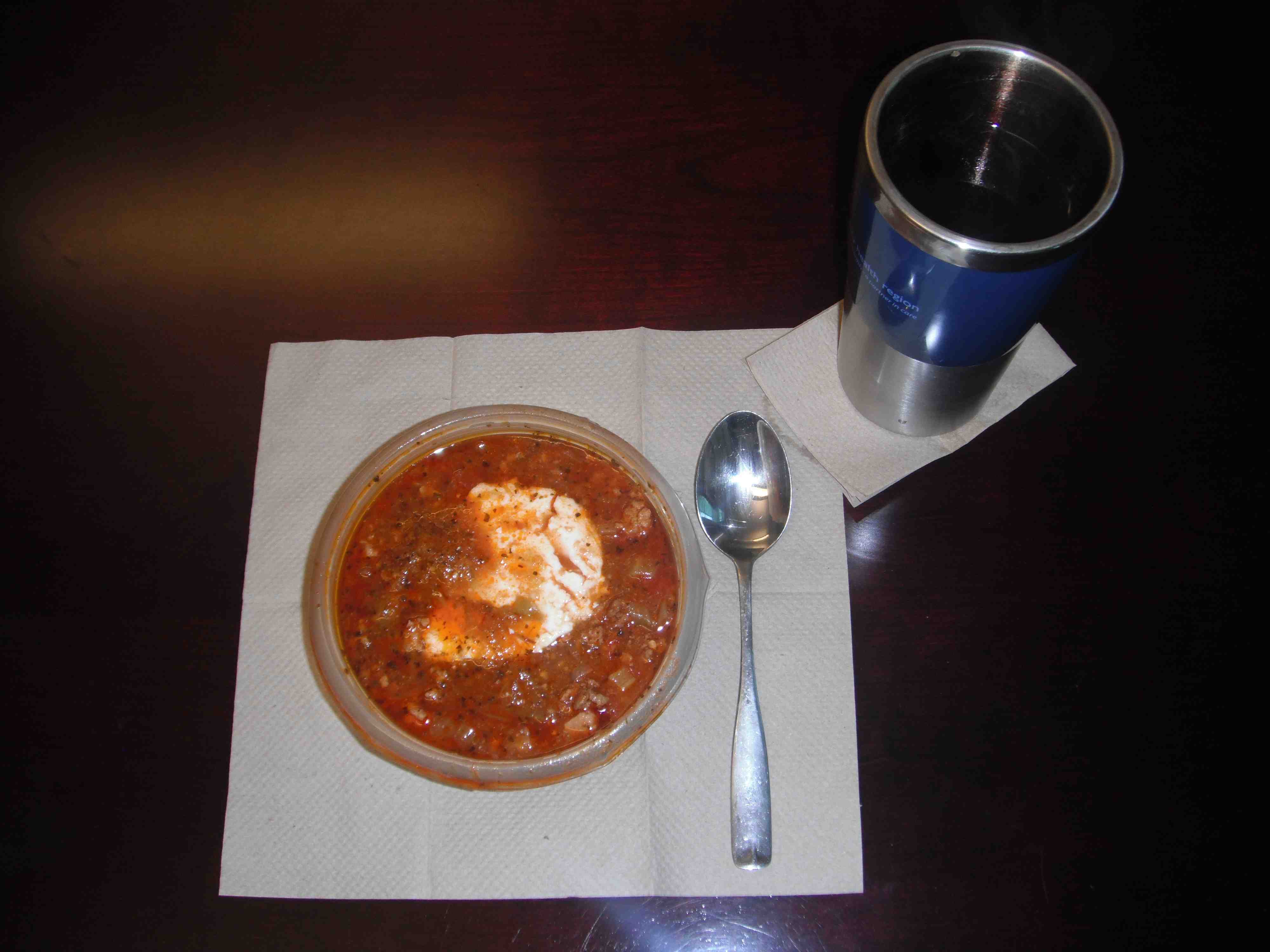
Lunch at my desk. This is my beanless chili. The recipe is adapted from one in "Everyday Paleo" by Sarah Fragoso. It is made with ground pork, ground beef, Italian sausage, Italian tomatoes, chicken stock, onions, celery, basil, oregano, cumin, chili powder, cayenne, salt and pepper. It is delicious served with a dollop of sour cream and some green salsa and accompanied by another cup of hot, black tea.


What would low-carb be without the occasional steak? This one was rubbed with olive oil and dusted with Montreal Steak Spice before being grilled. It is served with bocconcini and heirloom tomato on a bed of arugula, drizzled with olive oil and balsamic vinegar with some coarse sea salt and fresh basil. Note the glass of hearty red wine, a must when eating steak IMHO.


Halibut dinner. On a recent trip to Haida Gwaii, I was fortunate in being able to stock up on halibut. Here it has been rubbed with olive oil and dusted with a little garam masala and then baked in the oven. It is served with roasted cauliflower and anise that had been tossed with olive oil and coarse sea salt. Note that white wine goes with white meat and seafood but that it has more residual sugar than red wine. Having said that, I believe that one little glass is not going to upset the applecart, so to speak.

Low-carb birthday cake. Here is a chocolate birthday cake with whipped cream icing and fresh strawberries that I made for my son's eleventh birthday. The recipe is adapted from the one-minute chocolate cake recipe you can find on the recipe tab above. Enjoy!


My recent (and infrequent) blood test results

I have to confess that I don’t get my bloodwork done as often as I should. For type 2 diabetics, HbA1c is supposed to be done every three months and annual testing is recommended for lipids and kidney function as is an annual eye exam for signs of diabetic retinopathy. In my case, nine years post-diagnosis, I get my A1c done along with lipids and kidney function every 18 – 24 months, at best. My last eye exam was three or four years ago and I don’t test my fasting sugars at all. Is this irresponsible? Am I setting a poor example? Perhaps. But, before you judge, have a look at my most recent results:

Fasting glucose 5.7 (3.3-5.5) mmol/L

HbA1c 5.7 (4.5-6.0) %

Sodium 141 (134-145) mmol/L

Potassium 4.5 (3.5-5.0) mmol/L

Urea 6.5 (2.5-9.0)

Creatinine 73 (70-120) umol/L

Estimated GFR 97 (>60) mL/min

ALT 21 (<60) U/L

AST 23 (<35)U/L

CK 102 (<300) U/L

Total Cholesterol 5.82 (2.00-5.19) mmol/L

LDL Cholesterol 3.49 (1.50-3.39) mmol/L

HDL Cholesterol 2.05 (>0.90) mmol/L

Chol/HDL ratio 2.84 (<4.9)

Triglycerides 0.62 (0.45-2.29) mmol/L

Apolipoprotein B-100 0.95 g/L

TSH 2.4 (0.38-5.5) mU/L

C Reactive Protein 0.5 (<5.0) mg/L

What does it all mean? Well, according to the guidelines, my fasting glucose being slightly elevated means I am at risk for type 2 diabetes. This, coupled with the fact that my HbA1c is also on the high side of norma, if I were a non-diabetic, would indicate risk of diabetes and mandate further testing like an oral glucose tolerance test. In my case, however, since I am already diagnosed with type 2, those results are actually pretty good. The target for HbA1c in diabetes management is <7%, far higher than what is considered normal. Why is this? My opinion is that this reflects a tendency to move the goal posts when we can’t get better values with the conventional therapies. For people who use drugs and/or insulin, to get better values than that is difficult and possibly dangerous. In the ACCORD trial, where they threw the pharmaceutical kitchen sink at people to try to get better values, they actually ended up killing more people than with the conventional more relaxed approach. So, there is a tacit admission of defeat in this target in my opinion with physicians now believing that it is perhaps even dangerous to try to get down to normal HbA1c values in their patients. For those who understand that diabetes can be managed quite well by carbohydrate restriction, the achievement of normal HbA1c values is not surprising at all and certainly not dangerous.

My elevated fasting glucose suggests that I still have hepatic insulin resistance but not too severely.  It certainly isn’t leading to an elevated HbA1c and I don’t think I am experiencing hypoglycemia, at least that I can detect subjectively, so I am not too concerned with that one abnormal value.

As you can see, my kidney function is fine. My creatinine, which tends to rise if kidneys are diseased, is actually at the low end of the range, which is good. My glomerular filtration rate is also well into the normal range. That is good to know as kidney failure is a common complication of type 2 diabetes. Mine appear to be perfectly fine.

Ditto my liver. Based on these liver function test results, my liver does not appear to be under any kind of stress. So far, so good.

Now the interesting part, the lipid profile. Here is where I deviate a bit from the norm. My total cholesterol, LDL (so-called bad cholesterol) and HDL (good cholesterol) are all elevated. The numbers for cholesterol and LDL are not terribly high but if I were being managed according to the book, I would be a candidate for statins based on these results alone. In case you didn’t already know, I am not a big fan of statins, for myself or anyone else. I find the science is full of contradiction and I suspect that the evidence that statins are beneficial may be due to their anti-inflammatory effect rather than their effect on LDL.

Let’s look a little closer at my lipid results. My HDL is way up there, which is good because it turns out that the best predictor of cardiovascular risk is actually the Cholesteral/HDL ratio. In my case, I am well down into normal territory with that value. And my triglycerides are in the basement. This is good and is a common result of carbohydrate restricted dieting. Some argue that the ratio of HDL to triglycerides is a better predictor of CVD risk than the cholesterol ratio. If that is the case, I am in excellent shape here.

I also got an ApoB done for the first time. On it’s own, ApoB is supposed to be a marker of CVD risk. The ratio of ApoA to ApoB is supposed to be as good or better than the cholesterol/HDL ratio as a predictor. I didn’t get that done. Perhaps next time. ApoB also tells you something about the particle size of your LDL. Smaller particles are thought to be more dangerous. The lab didn’t report a normal range for ApoB but, digging around in the research literature, it is apparent that for men ApoB should be somewhere between 0.55-1.25 g/L. In a Framingham Offspring study, it was found that 1.00 g/L was at the 50th percentile and that men whose ApoB was greater than 1.20 had elevated CVD risk. With these data in mind, I am happy with my ApoB of 0.95 g/L.

As you can see, my thyroid appears to be functioning normally.

And, last but certainly not least, my CRP is very low. This may, arguably, be the most important test of the whole lot. We know that this whole range of chronic diseases, from obesity to metabolic syndrome to type 2 diabetes and cardiovascular disease, is underpinned by inflammatory processes. Jeff Volek et al, has been showing that if you follow a range of inflammatory markers, a low-carb diet delivers a powerful anti-inflammatory effect. We also know that these chronic conditions belie a state of high oxidative stress, as well. Oxidative stress and inflammation go hand in hand. We know that it is in that high inflammatory/high oxidative stress milieu that oxidization of cholesterol, damage to cell membranes, injury to blood vessels and interference with metabolic functions occur and that these drive chronic disease. If oxidative stress and inflammatory levels are low, the potential damage of higher LDL or elevated glucose is much less an issue. As I said earlier, it is perhaps the inflammation reducing effect of statins that delivers a benefit. Evidence in support of this idea can be found in the JUPITER study where a cohort of men with normal LDL but elevated CRP clearly benefitted from statin therapy.

I am not advocating statins, however, I am advocating carb-restriction. No drug, or combination of drugs, can deliver the range of therapeutic benefits that these blood tests demonstrate. I have a slide I use in my lectures which lists the 20 classes of drugs used to treat metabolic syndrome and type 2 diabetes. Meanwhile, one simple dietary change delivers a better result. If you subscribe at all to Occam’s Razor, you will know which is the right therapy.

These test results are consistent with my previous tests since I have been following a very low carb diet. Now, can you see why it is perhaps not irresponsible for me to test infrequently? Can you also see that, if more type 2 diabetics were to follow a low-carb diet as I do, there would be tremendous savings to the health care system, not just in testing but in reductions in complications as a result of improved management? At some point, the evidence will become so overwhelming that this will have to become the first line treatment. Or, the cost of the failure of the conventional approach will grow to the point that the current system of care will collapse under its weight.

I’ll report back again in a year or two … or three.


Why I missed AHS

And a big thank you to everyone who offered to help with WordPress.

BTW – the fish was released.